Blog Post #5 — The First Month Under Plan B (November Recap)
Published: December 2025
Hello
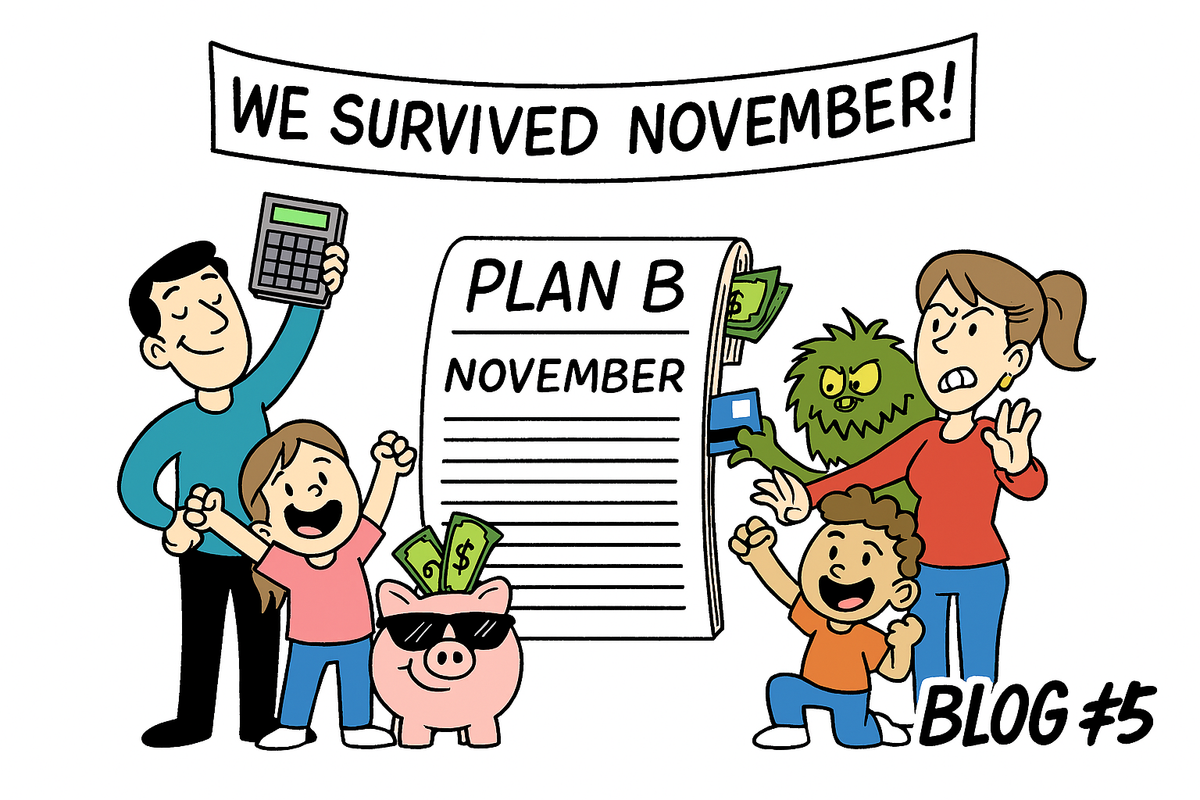
This post marks the first full month of Plan B operating in real life. Our family committed to a strict regimen of not spending money unnecessarily, and I’m genuinely proud of the discipline both my wife and I maintained.
Below is the AI‑assisted analysis of every transaction from 01 Nov 2025 to 30 Nov 2025, along with how Plan B’s “expected vs actual” model performed during its first true stress test.
First Month November 2025
November was the first real test of Plan B — not the planning phase, not the setup, not the theory.
This was the month where the system had to stand up to real paychecks, real bills, real spending, and real life.
And it worked.
Not perfectly. Not magically. But it worked the way a good system should:
it caught everything, it kept us honest, and it gave us control.
1. Income: Verified, Logged, and Predictable
November brought in all expected paychecks:
- Spouse Monthly Paycheck: received as scheduled
- Travis Biweekly Paycheck: received Nov 12
- Travis Biweekly Paycheck: received Nov 26
Plan B handled income exactly as designed:
- Deposits arrived as expected
- Transfers to savings buckets were logged
- Variance from expected income was tracked
- No surprises, no missing money, no confusion
Everything flowed smoothly with no unexpected events.
2. Bills & Recurring Expenses: Zero Ambiguity
Every recurring bill — mortgage, utilities, insurance, Netflix, T‑Mobile, student loans — was:
- Logged
- Categorized
- Matched to the correct paycheck
- Verified against the Master Due Date Map
The system even caught timing shifts (like Netflix drifting between the 13th–15th), and nothing slipped through the cracks.
This is exactly why the Due Date Map exists.
3. Debt Payments: Fully Executed
November included several major debt actions:
- Yamaha Loan: paid the targeted amount
- BCU Visa (Tuition): paid the targeted amount
- Spouse Student Loan: $100
- Travis Student Loan: $242.67
All payments were:
- Logged
- Categorized
- Reflected in the Master Debt List
- Matched to the correct paycheck
Plan B’s debt section is now fully active and functioning exactly as intended.
4. Savings: Tuition Buffer + Kids’ Mandatory Savings
November savings included:
- Kids’ Savings: completed (no value shown for privacy)
- Tuition Buffer: $433.25 transferred to Share 12
- Rainy Day Fund: no withdrawals (a win)
All savings actions were executed as expected.
5. Non‑Recurring Spending: Fully Captured (Debit + CC)
This is where Plan B really showed its strength.
Every single non‑recurring transaction — whether debit, credit, or cash — landed in Section 6:
- Groceries
- Fuel
- Household items
- Kids’ clothing
- Amazon orders
- Dining out
- Spouse discretionary
- Tuition charges
- Interest charges
Nothing was missed.
Nothing was miscategorized.
Nothing was left floating.
This is the cleanest month of spending data we’ve ever had.
6. Credit Card Activity: Fully Integrated
All three cards were reconciled:
BCU Visa (Tuition Card)
- Tuition charges: charged expected amount
- Interest: $69.99
- Dining out: $145.23
- Payment: paid targeted amount
Chase Amazon Prime Visa
- One Amazon order: used
Capital One (Wife)
Used for several transactions:
- LPAC event: Entertainment — we watched my wife perform in The Nutcracker as a party guest this year. It was fun.
- TeachersPayTeachers: Emotional spending — classroom materials
- Walmart.com: Household
- Amazon: Household
- Restaurant: Dining out
- Ballet (Dec): excluded from November
All CC spending is now part of the November ledger.
All CC payments are part of the debt section.
All balances are updated.
This is the first time our CC activity has been fully integrated into a monthly system.
7. Decision Log: Every Judgment Call Documented
Every reclassification, category correction, and rule clarification was logged:
- Kids’ clothing → Essential
- Amazon → Shopping (Discretionary)
- Tuition → Tuition Credit (Essential)
- Dining out → Discretionary
- Interest → Debt‑related
- Classroom supplies → Education (Essential)
This is the backbone of auditability.
8. System Performance: November Passed
Plan B handled:
- Real bills
- Real spending
- Real credit card activity
- Real debt payments
- Real savings
- Real variance
- Real life
And it stayed stable.
No section broke.
No category failed.
No part of the system contradicted another.
No transaction was lost.
This is what a working system looks like.
Thanks for stopping by. Goodbye
This post completes the first full monthly cycle under Plan B.
While the data is strong and I’m proud of how our family maintained control over spending, December brings Christmas — and any surplus we built will likely be used.
However, this might be the first Christmas we don’t put 80% of it on credit cards, and that alone is a major win.
Next post will cover the first pay period of December 2025.